2025 Student Design Awards Winners Gallery

CONGRATULATIONS TO OUR 2025 STUDENT DESIGN COMPETITION WINNERS
At the 2025 AIAPV Leadership + Design Awards at CELEBRATE DESIGN celebration, held on Thursday, October 16 at Marriott International's Corporate Headquarters in Bethesda, three outstanding student projects were recognized at this year's Excellence in Design Awards. AIAPV President Marc Feinstein, AIA joined by President-Elect Emily Lally, AIA, presented the awards to recipients in this year's new student design competition.
The Competition, sponsored by the Potomac Valley Architecture Foundation (PVAF), was open to current students or recent 2024 graduates from either an undergraduate/graduate school/community college located in the AIA Potomac Valley chapter region. Participants were tasked with selecting a completed studio project that reimagined an underutilized space within Maryland, Virginia, or Washington, D.C. The project was to reimagine the space to better serve the community, enhance its aesthetic appeal, and promote environmental sustainability.
Projects were evaluated on the following criteria: Creativity and Innovation; Sustainability; Contextual Integration and Site Sensitivity; Feasibility; and Visualization and Communication. Meet the Jury Team
Visit our 2025 Emerging Professionals and Professional Winners Galleries.
DESIGN AWARD – FIRST PLACE
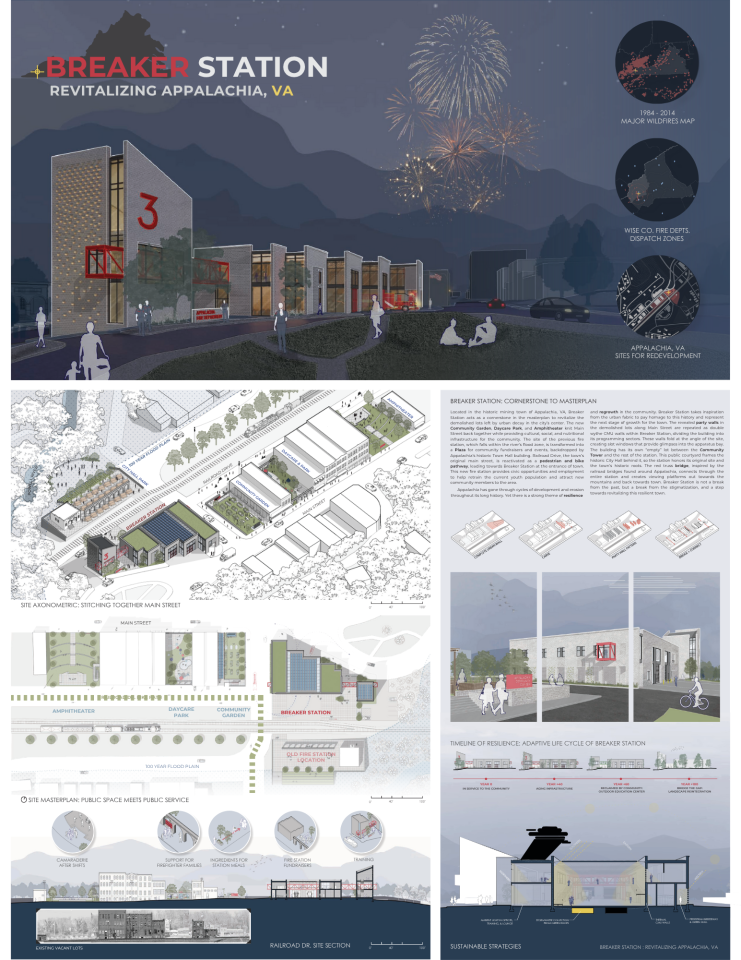
Project Breaker Station: Revitalizing Appalachia, VA
Appalachia, VA
Student Team Shannon Sinnicki and Melissa Johnson Arriagada
School University of Maryland, College Park
Professor Peter Noonan, FAIA
Course ARCH 601
View Project
PROJECT DESCRIPTION
This project reimagines Appalachia’s civic core through a masterplan that strengthens community ties, supports local firefighters, and honors the town’s heritage. New spaces—including an amphitheater, daycare park, community garden, and civic plaza—revitalize Main Street and Railroad Drive, linking past and present. The design fosters social connection, food access, and resilience through adaptable, locally built structures. Guided by community engagement, the plan balances immediate needs with long-term growth, creating a framework for a more connected, equitable, and sustainable future for Appalachia.
JURY
The jury found the project visually strong, with an interesting and well-thought-out concept that effectively met its design goals. They were impressed by the site and context analysis and appreciated how the design thoughtfully responds to its setting with an adaptive, forward-looking approach.
DESIGN AWARD – SECOND PLACE
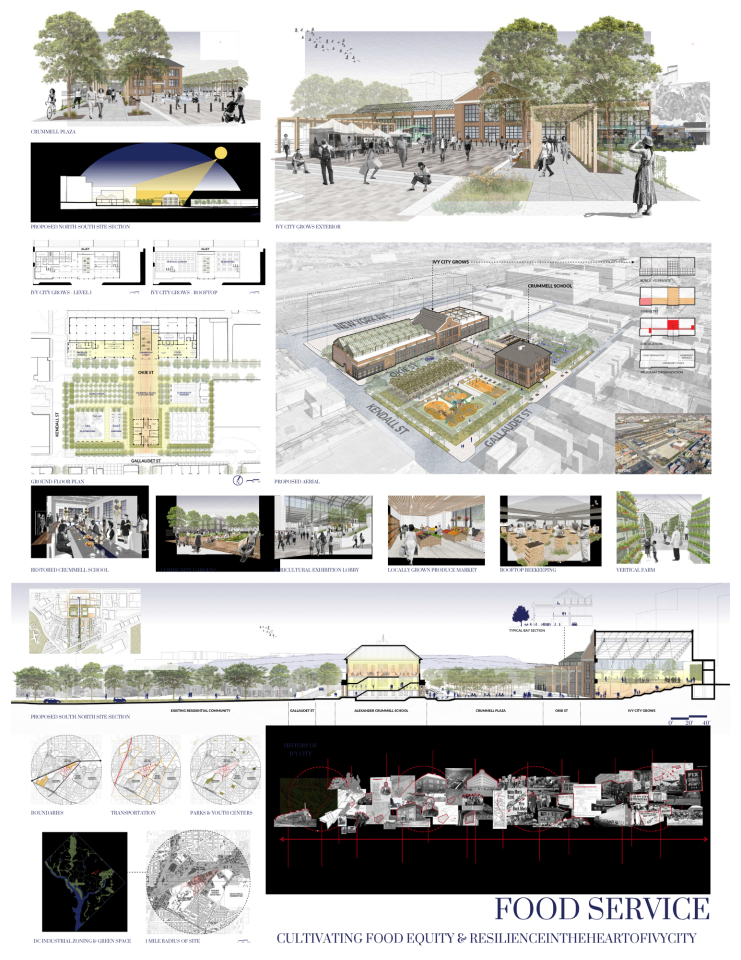
Project Food Service: Cultivating Food Equity & Resilience in the Heart of Ivy City
Ivy City, Washington, DC
Student Judy Tram
School University of Maryland, College Park
Professor Daniel Curry, AIA
Course ARCH799: Master’s Thesis Research
View Project
PROJECT DESCRIPTION
This thesis project explores how urban food infrastructure can address food inequity while strengthening community identity, ownership, and wellness in Washington, DC’s Ivy City neighborhood. The proposal envisions an urban agricultural facility serving as a community “third place,” connecting local residents with fresh food and educational opportunities. Guided by principles of resilience, heritage, and empowerment, the project promotes food citizenship and equitable access while reimagining food systems as catalysts for social, economic, and environmental transformation in historically underserved communities.
JURY
The jury felt this was a beautifully expressed and comprehensive project with a strong concept, innovative ideas, and excellent communication. The variety of spatial experiences and thoughtful site planning are impressive. The overall execution is outstanding—truly a well-conceived and inspiring project.
 DESIGN AWARD – HONORABLE MENTION
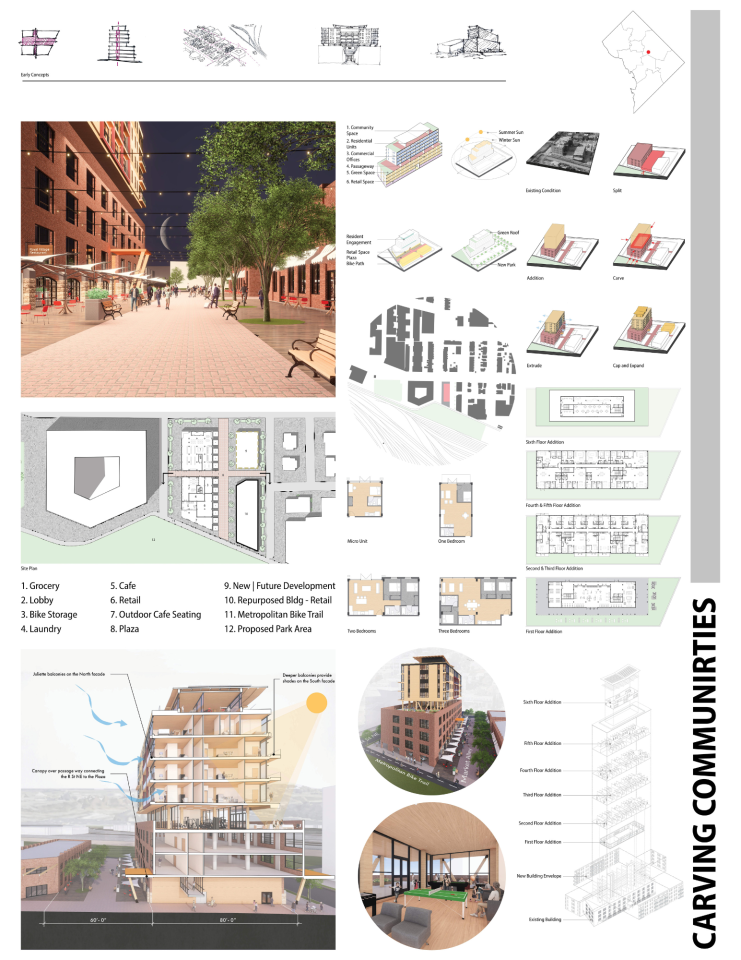
Project Carving Communities
Eckington, Washington, DC
Student Team Dieu Merci Kamate and Sergio Gomez
School University of Maryland, College Park
Professor Peter Noonan, FAIA
Course ARCH 601
View Project
PROJECT DESCRIPTION
Carving Communities transforms a historic Eckington building into a mixed-use hub that unites preservation, sustainability, and community engagement. It adds affordable housing, civic spaces, and a plaza linked to Alethia Tanner Park while activating the ground floor with retail and offices for local businesses. Using mass timber reduces carbon impact and preserves the building’s heritage. Guided by community partnerships, the project fosters inclusive growth, expands green space, and strengthens neighborhood identity.
JURY
The jury felt that Carving Communities was an intriguing concept with good visuals.