
2025 Emerging Professionals Design Awards Winners Gallery

CONGRATULATIONS TO OUR 2025 EMERGING PROFESSIONALS DESIGN COMPETITION WINNERS
At the 2025 AIAPV Leadership + Design Awards at CELEBRATE DESIGN celebration, held on Thursday, October 16 at Marriott International's Corporate Headquarters in Bethesda, three outstanding emerging professional design projects were recognized at this year's Excellence in Design Awards. AIAPV President Marc Feinstein, AIA joined by President-Elect Emily Lally, AIA, presented the awards to recipients in this year's new emerging professionals design competition.
The Competition, sponsored by the Potomac Valley Architecture Foundation (PVAF), was open to individuals and small teams of up to four participants, with the primary entrant required to be a current AIA Potomac Valley member. Participants were tasked with selecting an underutilized urban space within Maryland—either a vacant lot, an abandoned building, or a neglected park. The goal was to reimagine the space to better serve the community, enhance its aesthetic appeal, and promote environmental sustainability.
Projects were evaluated on the following criteria: Creativity and Innovation; Sustainability; Contextual Integration and Site Sensitivity; Feasibility; and Visualization and Communication. Meet the Jury Team
Visit our 2025 Student and Professional Winners Galleries.
 DESIGN AWARD – FIRST PLACE
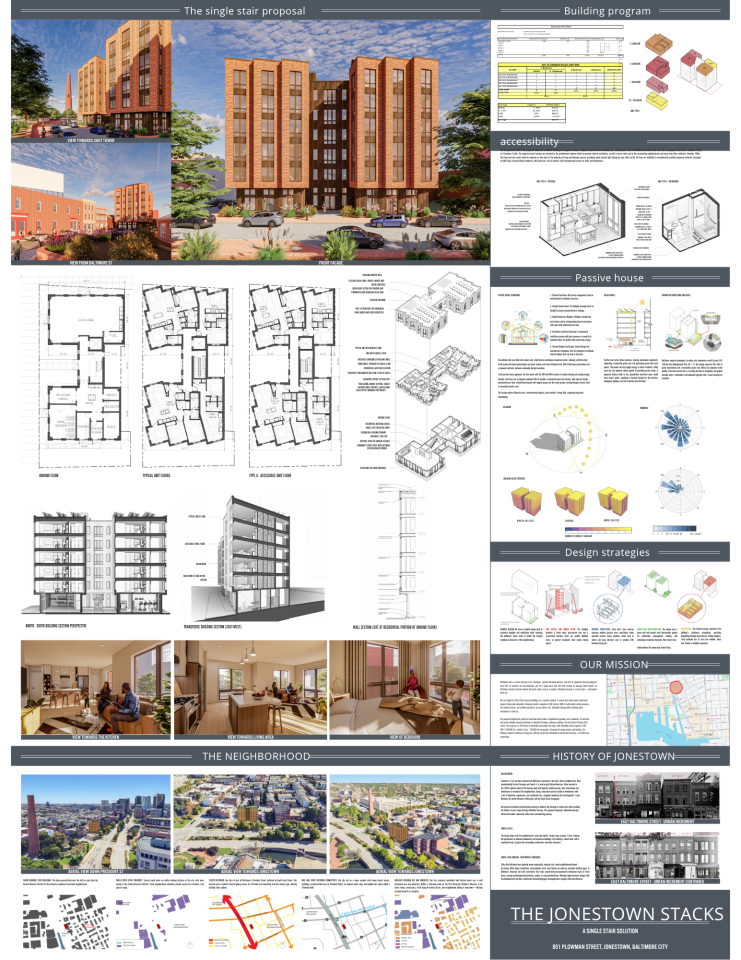
Project The Jonestown Stacks
Jonestown, Baltimore, Maryland
Design Team Rafael Gonzalez, David Otieno, Jo-Elisa Clarke, Brandon Clear
Architecture Firm Torti Gallas + Partners, Inc.
View Project
PROJECT DESCRIPTION
Jonestown Stacks reintroduces Baltimore’s missing single-staircase typology with a five-story, 20-unit building over a one-story podium. Located at the neighborhood gateway, its red brick and weathered metal design honors the city’s industrial heritage and surrounding townhouses. The project offers a mix of market-rate and affordable housing, including units at 50% AMI, designed to Fair Housing standards. By combining contextual design with incremental densification, Jonestown Stacks supports diverse, accessible, and vibrant community living.
JURY
The jury thought that this project presented a clear statement and that the design effectively reinforces the project goals. Very well thought out, with an interesting use of a novel code from another jurisdiction to push the boundaries of design. The jury is interested to see whether the codes would allow it.
DESIGN AWARD – SECOND PLACE
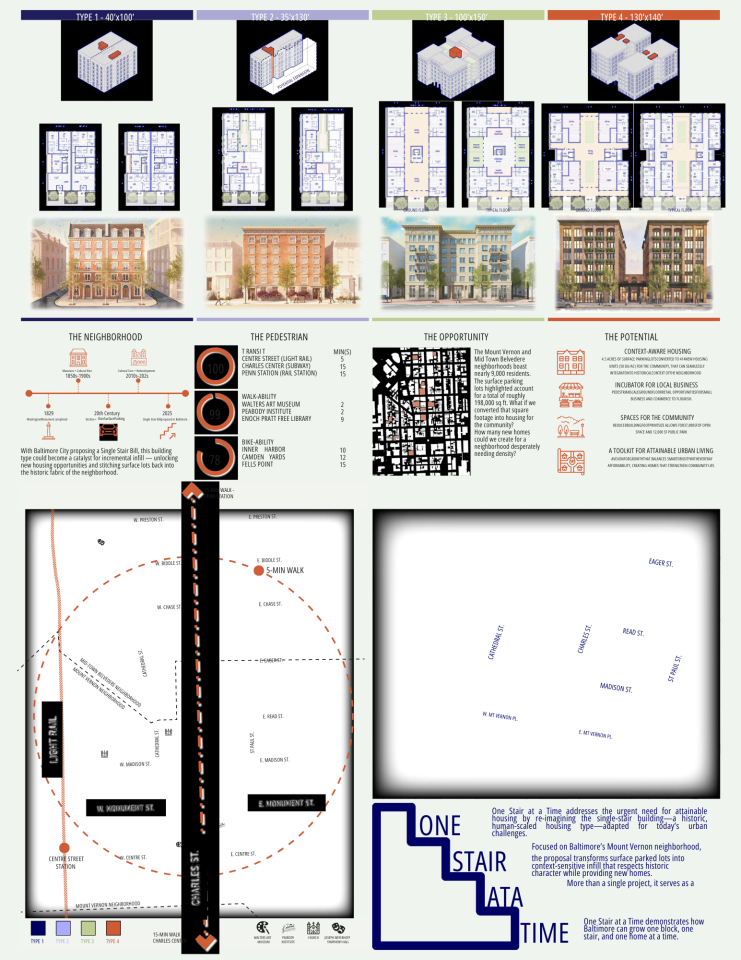
Project One Stair at a Time
Mount Vernon, Baltimore, Maryland
Design Team Thomas Long and Rafael Gonzalez
Architecture Firm Torti Gallas + Partners, Inc.
View Project
PROJECT DESCRIPTION
One Stair at a Time transforms underutilized lots in Baltimore’s Mount Vernon into human-scaled “missing-middle” housing, offering 414 new homes alongside parks, courtyards, and pedestrian-friendly plazas. Using adaptable single-stair building types, the project preserves historic character while enhancing walkability, community, and local economic activity. Ground-floor retail and creative spaces support culture and entrepreneurship, while sustainable design reduces heat islands and improves stormwater management. Collaborative engagement ensures affordability, neighborhood alignment, and a resilient, livable urban fabric.
JURY
The jury was particularly impressed by the project’s presentation. The design board was clear, concise, and communicated the ideas effectively.
 DESIGN AWARD – THIRD PLACE
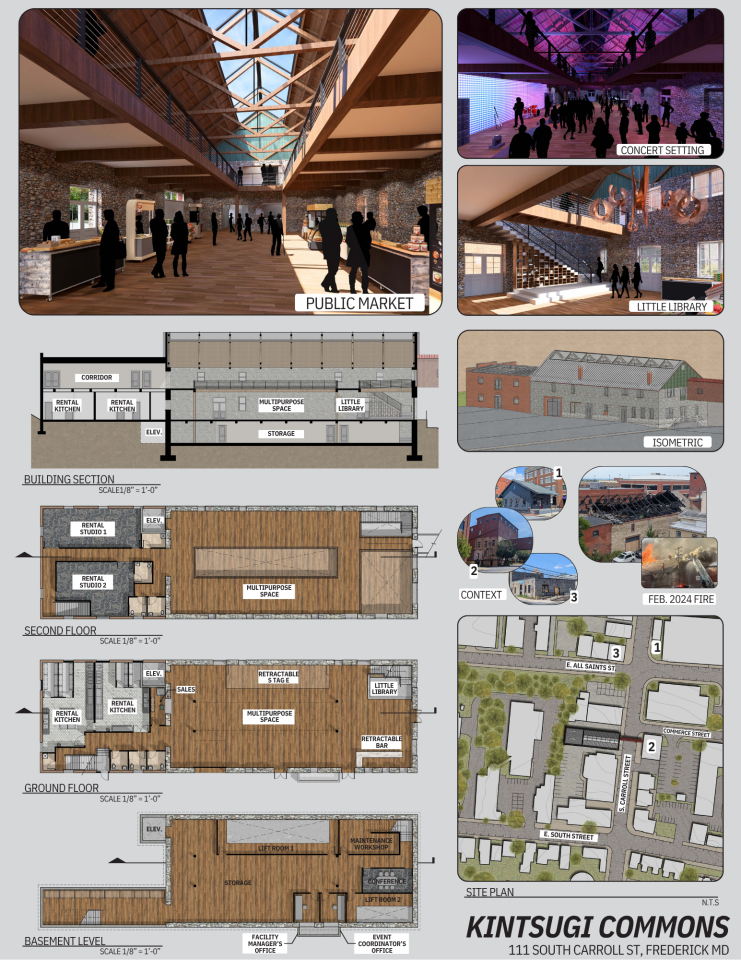
Project Kintsugi Commons
Cannon Hill, Frederick, Maryland
Design Team Finn Shamieh
Architecture Firm Archive Design
View Project
PROJECT DESCRIPTION
Kintsugi Commons revitalizes a historic Frederick granary, transforming it into a flexible, multi-functional community hub. The space includes a two-story event hall with a retractable stage and bar, rental commercial kitchens, sales areas, a community library, and two studios for small businesses or artists. Hosting markets, concerts, workshops, and celebrations, it fosters everyday engagement and supports local entrepreneurship, while preserving the building’s historic exterior and celebrating its past through adaptive reuse.
JURY
The jury thought this project was highly feasible and thoughtfully contextual, demonstrating strong integration with its surroundings. They agreed it was well conceived, met the criteria effectively, and would serve the community well.